|
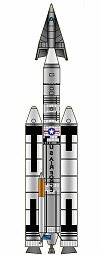
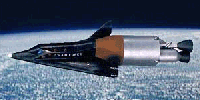
On 16 October 1961 the USAF Aeronautical Systems Division (ASD) revamped the Dyna-Soar, scrapping earlier plans for suborbital and orbital missions launched on less powerful versions of the Titan in favor of orbital missions launched on the Titan IIIC, which the Air Force palled to develop as its standard heavy-lift launch vehicle. The launch vehicle's multi-restartable upper stage, called Transtage, would remain attached to the spacecraft to provide orbital maneuverability, including transfers to and from high Earth orbit. This upgrade of the Dyna-Soar program occurred in the context of the SAINT (SAtellite INTerceptor) II study issued by the USAF Space Systems Division (SSD) in May 1961, which ASD saw as a competitor for funding. To end-run the SSD initiative, ASD incorporated into its Dyna-Soar new capabilities that SSD was touting for its SAINT II proposal. As a nod to the political sensitivities of the Kennedy administration, which was promoting the peaceful uses of space, ASD made no mention of the Dyna-Soar upgrades as being aimed toward performing the satellite interception mission that caused the civilian leadership to balk, yet this must have been understood tacitly by both the military and the civilians.
ASD's programmatic maneuver firmed up support for Dyna-Soar among the former; however, the latter remained skeptical of military utility of the program given its expense, especially as the switch to the more powerful Titan IIIC launch vehicle resulted in a more expensive program. The knock against earlier visions of the Dyna-Soar had been that there was not very much that it could do other than go up and come back down again; in this respect it had not evolved very far from its roots as a suborbital research vehicle, a super X-15. In its new incarnation as a manned SAINT in all but name, it aspired to a mission that no one would acknowledge publicly and that the civilian leadership continued to view with some hostility.
The Kennedy administration continued to fund the Dyna-Soar program for two more years, during which funding restrictions forced reduction in the number of planned missions from 18 to ten. Additional de-scoping of the program involved offsetting the number of extended high Earth orbital missions with more short-duration, low Earth orbital missions while keeping the overall number of launches to ten. As of March 1962, the ninth manned extended high Earth orbital mission was probably scheduled to be launched in December 1967, interpolating from multiple documents.
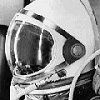
Although the Dyna-Soar program was terminated before the Air Force assigned astronauts to specific flights, it did select a group of test pilots for Dyna-Soar in April 1960:
The Air Force had previously selected Neil A. Armstrong in 1958 for its Man In Space Soonest program. NASA selected him in Group 2 on 17 September 1962.
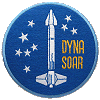
The Dyna-Soar program insignia shown above depicts the spacecraft on a Titan II.
References:
USAF. 1960. "Dyna Soar Characteristics Summaries." September.
Geiger, Clarence J. 1963. "History of the X-20A Dyna-Soar." Vol. 1. Aeronautical Systems Division, Wright-Patterson AFB, Ohio, p. 88.
Godwin, Robert, ed. 2003 Dyna-Soar: Hypersonic Strategic Weapons System." Apogee Books Space Series 35 Paperback, p. 50.
Strom, Steven R. 2004. "Jurassic Technology: The History of the Dyna-Soar." Crosslink, Winter, pp. 6-9. Aerospace Corporation.
Encyclopedia Astronautica.
Wikipedia.
|
|

N A Armstrong

W H Dana
H C Gordon

W J Knight

R L Rogers
M O Thompson
J W Wood
|