Dyna Soar 14Spacecraft:(no serial number) Launch Vehicle: Titan I Scheduled Launch: 1 Dec 1965 Last Scheduled: 1 Nov 1960 |
|
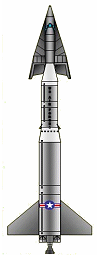
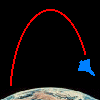
Description: 12th Dyna-Soar Titan I manned suborbital |
 |
 |
 |

not assigned 
|
Backup Crew |
not assigned
|
|
|
||||||||
|
|
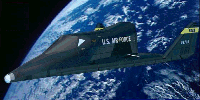
The Dyna-Soar program evolved through several stages during its five-year history from the award of the first contract, ultimately gaining the designation of X-20. In its initial form, the Dynamic Soaring glider was to be launched on suborbital flights using the Titan I launch vehicle. Because of the increasing design weight of the spacecraft, in February 1961 the program switched to the more powerful Titan II for suborbital missions. The date of the 12th manned suborbital flight on the last schedule before the switch is inferred from the two-month launch centers that were a regular feature of previous scedules. Although the Dyna-Soar manned suborbital program was terminated before the Air Force assigned astronauts to specific flights, it did select a group of test pilots for Dyna-Soar in April 1960:
The Air Force had previously selected Neil A. Armstrong in 1958 for its Man In Space Soonest program. NASA selected him in Group 2 on 17 September 1962. The Dyna-Soar program insignia shown above depicts the spacecraft on a Titan II. References:
|

N A Armstrong 
W H Dana 
H C Gordon 
W J Knight 
R L Rogers 
M O Thompson 
J W Wood |