SAINT II-3Spacecraft:(no serial number) Launch Vehicle: Titan II/Chariot Scheduled Launch: 1 Aug 1964 Last Scheduled: 29 May 1961 |
|
Description: 3rd SAINT II Titan II/Chariot unmanned orbital |
 |
 |
 |
|
|
|
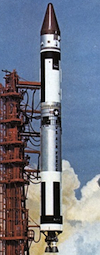
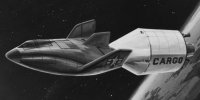
At the beginning of the 1960s, the USAF examined a number of approaches to a manned spacecraft designed to rendezvous with, inspect, and then, if necessary, destroy enemy satellites. These studies were called SAINT (SAtellite INTerceptor). The initial SAINT study was of an unmanned system. SAINT II aimed to develop a manned system. On 29 May 1961 the USAF Space Systems Division (SSD) near Los Angeles announced its SAINT II manned space interceptor concept. This was to be a two-man lifting body spacecraft, using subsystems developed for the SAINT I unmanned satellite inspector. (Coincidentally, SSD issued its Lunex manned lunar base study the same day. The Lunex spacecraft was to be a three-man lifting body of similar shape to the two-man SAINT II.) SAINT II would be capable of orbital rendezvous and limited space logistics missions. The launch vehicle would be a Titan II equipped with a Chariot fluorine/hydrazine high-performance third stage (an early concept of the USAF's 1958 Man In Space Soonest (MISS) study included a fluorine/hydrazine system as the second stage of a Thor launch vehicle). Twelve manned orbital missions would be conducted starting in November 1964, including both low and high Earth orbital flights. SSD argued that Dyna-Soar, which was managed by the USAF Aeronautical Systems Division outside of Dayton, did not have the capability to perform the mission satellite interceptor, due to its limited payload, and its restriction to low earth orbit and to short duration missions. The knock against Dyna-Soar I had always been that there was not very much that it could do other than go up and come back down again; in this respect it had not evolved very far from its roots as a suborbital research vehicle, a super X-15. The Dyna-Soar program hoped to evolve the system into a design having military utility in phases II and III, which could not become operational until the end of the 1960s and in the mid 1970s, respectively. In contrast, SSD's SAINT II concept offered the possibility of a useful system in the mid 1960s that, like Dyna-Soar, would have crossrange reentry capability and land on a runway. In response, Dyna-Soar advocates, who saw the SAINT II concept as a competitor for funding, critcized the SAINT II program as unrealistic in schedule and budget. Also, both the civilian DoD leadership and the White House was cool to the idea as they wished to promote the peaceful use of outer space. In the face of this opposition, the SAINT II study went nowhere and the idea was dead by late 1961. It must also be noted in retrospect that fluorine/hydrazine propulsion concepts quickly lost their allure, despite the promise of high specific impulse, due to the toxicity and corrosiveness of these propellants. However, the SAINT II study served as a shot across Dyna-Soar's bow which forced a sudden evolution of that project away from Titan II suborbital and Titan II/Centaur short-duration, low Earth orbital flights. In the environment created by the SAINT II challenge, the question of what use Dyna-Soar was going to be in orbit in the near-term demanded an immediate answer. In October 1961 the Dyna-Soar program office announced the cancellation of all suborbital flights and the switch to the more powerful Titan IIIC launch vehicle for a program that would begin with short-duration low Earth orbital missions in 1965 and early 1966, and progress to extended-duration missions in high Earth otbit beginning in mid-1966. The prospect that with such improvements Dyna-Soar might assume the satellite interceptor role was soft-pedalled in view of Kennedy administration sensitivities toward the weaponization of outer space. A final legacy of the SAINT II study was that the preferred design of a lifting body led eventually to the X-23A PRIME subscale model flight tests and the X-24A manned research aircraft program. The launch date for a third unmanned mission is based on the assumption of three-month launch centers. The launch vehicle shown above is a Titan IIIA; the spacecraft shown above is later concept of the SV-5 lifting body shape configured for orbital missions. References:
|
