Outpost 1Spacecraft:(no serial number) Launch Vehicle: Atlas Scheduled Launch: 1 Jul 1963 Last Scheduled: 1 Apr 1958 |

|
Description: 1st Outpost Atlas unmanned wet space station |
 |
 |
 |
|
|
|
|
|
|
||||||||||
|
|
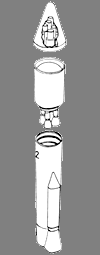
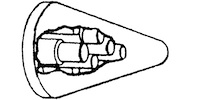
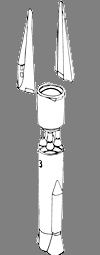
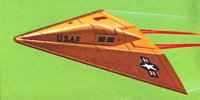
In April 1958, Krafft Ehricke, then with General Dynamics' Convair Division, designed a four-man space station known as Outpost. Ehricke proposed that the Atlas ICBM being developed by Convair could be adapted as the station's basic structure. Once inserted into orbit, residual RP-1 fuel would be vented to space, and the liquid oxygen would simply be allowed to boil to a gaseous state to provide a shirtsleeve environment for visiting crews. The concept was the progenitor of the "wet workshop" that would be developed from Saturn upper stages in the mid-1960s. The Atlas, 3 m in diameter and 22.8 m long, was America's largest rocket at the time. It was anticipated that the station could have been operating within five years from project approval; the July 1963 launch date assumes a FY 1959 new start. An unmanned cargo vehicle would have been launched several days after the space station on an Atlas with an undefined upper stage (the dimensions of the stage suggest the Vega, which NASA began to develop soon after Ehricke's proposal. The third launch in the sequence, again an Atlas with an upper stage, would have placed twin 2-man winged spacecraft in orbit to dock with the space station. References:
|