Mercury Atlas 7Spacecraft:S/C-18 Launch Vehicle: Atlas 107-D Launched: 24 May 1962 |

Prime Crew |
Description: 2nd Mercury Atlas manned orbital |
 |
 |
 |
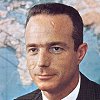
M S Carpenter 
|
Backup Crew |

W M Schirra
|
|
|
||||||||
|
| Duration: 0.21 days
Decay Date: 1962-05-24 USAF Sat Cat: 295 COSPAR: 1962-Tau-1 Apogee: 260 km (160 mi) Perigee: 154 km (95 mi) Inclination: 32.5000 deg Period: 88.50 min Scott Carpenter in Aurora 7 is enthralled by his environment but uses too much orientation fuel. Yaw error and late retrofire caused the landing impact point to be over 300 km beyond the intended area and beyond radio range of the recovery forces. Landing occurred 4 hours and 56 minutes after liftoff. Astronaut Carpenter was later picked up safely by a helicopter after a long wait in the ocean and fears for his safety. Deke Slayton was to have been the second American in orbit. When Slayton was selected as an astronaut in 1959, it was known he had a minor heart fibrillation. This however did not prevent him from being an Air Force test pilot or being selected as an astronaut. He was removed from flight status in March 1962. Slayton's three orbit flight would have been called Delta 7. Instead Carpenter was selected for the mission, and Schirra, Slayton's backup, was moved to the Mercury 8 flight. Slayton's flight is sometimes referred to as a canceled mission; more accurately, the same mission was performed with a different crew. References:
|