Mercury Atlas 6Spacecraft:S/C-18 Launch Vehicle: Atlas 109-D Scheduled Launch: 31 Dec 1961 Last Scheduled: 31 Oct 1961 |

Prime Crew |
Description: 2nd Mercury Atlas chimpanzee orbital |
 |
 |
 |
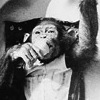
Minnie 
|
Backup Crew |
unknown
|
|
|
||||||||
|
A third unmanned Mercury Atlas orbital mission appeared program documents as late as 31 October 1961. The flight schedule chart in October 1961 showed an MA-6 alternate mission. This meant that if the Enos (MA-5) flight had not succeeded another chimpanzee mission, designated MA-6, would have been flown. As the backup to both Ham (Mercury Redstone 2) and Enos (Mercury Atlas 5), Minnie would have been a likely candidate to fly this mission. The program insignia shown above is post factum. Following the flight of Enos on Mercury Atlas 5, the astrochimps disappeared from pubic interest and from history. Not all of the names of the chimpanzees who trained for spaceflight are known; indeed, some of them may not have been given names. Ham, who flew on Mercury Redstone 2, was known as No. 65 before his flight, and only renamed "Ham" upon his successful return to earth. This was reportedly because officials did not want the bad press that would come from the death of a "named" chimpanzee if the mission were a failure. Among his handlers, No.65 had been known as Chop Chop Chang. There were originally 40 chimpanzee flight candidates at Holloman Air Force Base ("Ham" was actually an acronym for "Holloman AeroMedical"). After evaluation the number of candidates was reduced to 18, then to six. Aside from Ham and Enos, four other names are known, and it may be that these were the other four finalists. Minnie, who was the backup on both Mercury Redstone 2 and Mercury Atlas 5, as well as the apparent prime for the canceled Mercury Atlas 6, was one of four females in Colony 1 in quarters behind Hangar S at Cape Canaveral. Other Mercury-trained chimpanzees included Duane, Jim, and Rocky. It should be remembered that the astrochimps were not mere passengers or live payload; they were crew, albeit nonhuman, and despite the fact that obviously they did not pilot their spacecraft (although NASA's official history of Project Mercury refers to them as "pilots"). They were trained extensively to perform tasks during their missions, and aerospace medicine evaluated their performance as indicators of how spaceflight might affect the performance of human astronauts. In terms of being mission-essential, on a human scale the astronaut chimpanzees would rank above spaceflight participants; the closest equivalent human position would be payload specialist. When viewed in this way, it is an irony that as pilot of Mercury Atlas 6, John Glenn followed payload specialist Enos's Mercury Atlas 5 into space, on his second flight 36 years later he served as a payload specialist on STS-95. References:
|