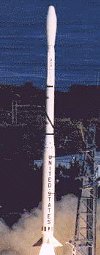
Mercury Scout 3Spacecraft:(no serial number) Launch Vehicle: Blue Scout II D-8 Scheduled Launch: 1 Jul 1963 Last Scheduled: 19 Apr 1961 |
|
Description: 2nd Mercury Scout unmanned docking target |
 |
 |
 |
|
|
||||||||
|
|
||||||||
|
|
In April 1961, John C. Houbolt and members of the Langley Research Center subcommittee on rendezvous outlined the objectives of a rendezvous program called MORAD (Manned Orbital Rendezvous and Docking) that would lead ultimately to a manned lunar landing:
As proposed by Houbolt's team, rendezvous in space between a Mercury spacecraft and Scout payload would establish confidence in manned rendezvous techniques and lead to simplification of equipment and increased reliability. It should also be noted that a paper (date unknown, HSI-16056) by Robert O. Piland and Herbert G. Patterson presented the concept of a Mercury rendezvous with an Atlas/Agena-launched SAINT-type spacecraft. Three key projects were described which would accomplish these objectives. The first was MORAD; the second key project was ARP (Apollo Rendezvous Phases), in which the Atlas, Agena, and Saturn boosters would be used in the 1962-1965 period. This program would accomplish rendezvous with space stations, personnel transfer, resupply of space laboratory, execution of space maneuvers after coupling (steps toward lunar landing), and development of specifications for subsequent orbital and moon missions. The third project was called MALLIR (Manned Lunar Landing Involving Rendezvous), in which Saturn and Apollo components would be used during the 1961-1967 period. After qualification of the Saturn components for rendezvous operations, an early manned lunar landing would take place. The launch date of July 1963 is speculative. Within four months, the MORAD concept evolved into the Agena rendezvous and docking subprogram of Mercury Mark II, the second such mission being scheduled for November 1963. Given that Mercury Mark II was evolving into a far more capable spacecraft than even the long-duration Mercury (beyond the Manned One-Day Mission), a one-for-one schedule slip over four months is probable. Interpolating from other NASA planning documents, such a mission would have fallen in the time frame for the 16th Mercury Atlas mission. References:
NASA. 1961. "Project Apollo Schedule." 20 January. HSI-16093.
|

M S Carpenter 
L G Cooper 
J H Glenn 
V I Grissom 
W M Schirra 
A B Shepard 
D K Slayton |