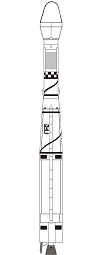
MISS 18Spacecraft:(no serial number) Launch Vehicle: Thor/Nomad Scheduled Launch: 1 Aug 1960 Last Scheduled: 11 Sep 1958 |
|
Description: 3rd MISS Thor/Nomad unmanned orbital |
 |
 |
 |
|
|
|
The beginning of the Air Force's Man In Space Soonest (MISS) program has been traced back to a staff meeting of General Thomas S. Power, Commander of the Air Research and Development Command (ARDC) in Baltimore on 15 February 1956. Power wanted studies to begin on manned space vehicles that would follow the X-15 rocketplane. These were to include winged and ballistic approaches - the ballistic rocket was seen as being a militarily useful intercontinental troop and cargo vehicle. The Soviet Union launched Sputnik 1 on 4 October, creating a political furor and giving new priority and urgency to the military's space efforts. On 15 October the NACA held a technical conference to resolve the final configuration for the Manned Glide Rocket Research System. The agreed delta-winged flat-bottom configuration would evolve into the X-20 Dyna-Soar. Nevertheless, interest continued in the ballistic reentry vehicle as a more immediate approach to human spaceflight, and this was the track that MISS pursued. The first launch vehicle considered for the project was the Thor IRBM, as the Atlas ICBM had yet to prove itself. The smaller Thor would need to have been mated with a highly energetic upper stage to place a spacecraft in orbit. Since technology to use liquid hydrogen had yet to be developed, the only choice was the Nomad design using hydrazine and liquid flourine propellants, as this combination yielded a very specific impulse. In March 1958 a development program was sketched out, requiring the flight of 10 Thor/Ables for initial tests and primate flights, to be followed by 20 Thor/Nomad flights. The first manned mission was to occur on the tenth Thor/Nomad flight. However, doubts remained regarding the practicality of using hydrazine and liquid flourine as rocket propellants due to toxicity and corrosiveness. Another look at Atlas performance figures suggested that it would be able to place the MISS spacecraft in orbit without the need for a second stage, saving both cost and development time, and the Air Force switched to the Atlas as the orbital launch vehicle for MISS. References:
|
