MERSpacecraft:(no serial number) Launch Vehicle: Atlas Scheduled Launch: 1 Dec 1960 Last Scheduled: 1 Apr 1958 |
Prime Crew |
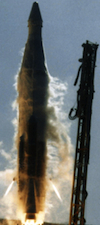
Description: 1st MER Atlas manned orbital |
 |
 |
 |

not assigned 
|
Backup Crew |
not assigned
|
|
|
||||||||
|
|
In April 1958 the Navy Bureau of Aeronautics presented to ARPA the results of its manned satellite study, "MER I" (for "Manned Earth Reconnaissance"). This approach called for an orbital mission in a novel vehicle - a cylinder with spherical ends. After being fired into orbit by a two-stage booster system, the ends would expand laterally along two structural, telescoping beams to make a delta-wing, inflated glider with a rigid nose section. The configuration met the principal MER I requirement: the vehicle would be controllable from booster burnout to landing on water. Fabric construction obviously implied a new departure in the design of reentry vehicles. At ARPA's direction the Bureau of Aeronautics undertook a second study (MER II), this one to be done jointly on contract by Convair, manufacturer of the Atlas, and the Goodyear Aircraft Corporation. The Convair-Goodyear study group did not make its report until December. At that time it reasserted the feasibility of the lifting pneumatic vehicle but relegated the inflation of the craft to the post-entry portion of the mission. By December, however, Project Mercury already was moving ahead steadily under NASA. Funds for a MER III phase (model studies) were not forthcoming from the Defense Department, and the intriguing MER concept became a little-known aspect of the prehistory of manned orbital flight. Project MER was by far the most ambitious of the manned space flight proposals made by the military in 1958. Its emphasis on new hardware and new techniques meant it really had little chance for approval then. References:
|