Lunex Subscale 2Spacecraft:(no serial number) Launch Vehicle: Atlas D Scheduled Launch: 1 Feb 1962 Last Scheduled: 29 May 1961 |
|
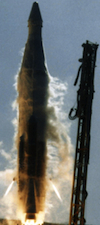
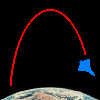
Description: 2nd Lunex Atlas subscale suborbital |
 |
 |
 |
|
|
|
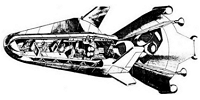
In May 1961, just as US President John F. Kennedy announced that NASA should put an American on the moon, the US Air Force released a secret report, summarising the result of years of planning to place a military base on the moon by 1967. Lunex was not a race against the Russians, but rather a plan to achieve the 'strategic high ground'. The report reveals the reason for USAF support of development of the advanced and large rocket engines begun in the late 1950's: the LR-115 (RL-10), J-2, F-1, M-1, and large solid rocket motors. The RL-10, designed for the USAF from the beginning as a throttleable motor for the Lunex lunar lander, finally put this capability to use twenty years later in the DC-X VTOL vehicle. The project would have started with a series of five Atlas-launched suborbital flights of subscale models of the Lunex lifting body vehicle based on the SV-5 wind tunnel model. Although this series never flew, the US Air Force eventually conducted a similar series of Atlas-launched suborbital flights of SV-5D subscale vehicles in 1966 and 1967 as the X-23A PRIME program. References:
|
