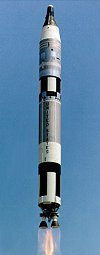
Gemini 1Spacecraft:S/C-1 Launch Vehicle: Titan II GLV-1 12556 Launched: 8 Apr 1964 |
|
Description: 1st Gemini Titan II unmanned orbital |
 |
 |
 |
|
|
||||||||
|
Decay Date: 1964-04-12
The mission's primary purpose was to verify the structural integrity of the GLV and spacecraft, as well as to demonstrate the GLV's ability to place the spacecraft into a prescribed Earth orbit. Mission plans did not include separation of the spacecraft from the second stage of the vehicle, and both were inserted into orbit as a unit six minutes after launch. The planned mission encompassed only the first three orbits and ended about four hours and 50 minutes after liftoff. No recovery was planned for this mission, but NASA continued to track the spacecraft until it reentered the atmosphere on 12 April 1964 on the 64th orbital pass over the southern Atlantic Ocean and disintegrated. The flight qualified the GLV and its systems and the structure of the spacecraft. References:
|
