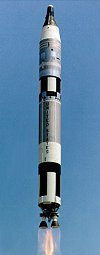
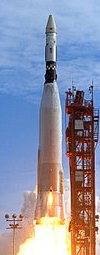
GATV AF-1Spacecraft:(no serial number) Launch Vehicle: Atlas D/Agena B Scheduled Launch: 1 Mar 1965 Last Scheduled: 1 Oct 1962 |
|
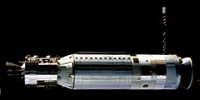
Description: 1st Atlas Agena unmanned docking target for manned USAF Gemini |
 |
 |
 |
|
|
||||||||
|
|
||||||||
|
|
Blue Gemini was a United States Air Force (USAF) project first proposed in August 1962 for a series of seven flights of Gemini spacecraft to enable the Air Force to gain manned spaceflight experience prior to the launch of the Manned Orbital Development System, or MODS. The plan was to utilize off-the-shelf Gemini spacecraft. Blue Gemini would consist of two National Aeronautics and Space Administration (NASA) missions which would include a USAF co-pilot and would accomplish NASA objectives. These would be followed by two more NASA missions that would have USAF crews. Those missions would be devoted to NASA goals, but would include USAF experiments if possible. The final phase of Blue Gemini would consist of three dedicated USAF missions. One of these would be an Agena Target Vehicle rendezvous mission and it was possible that some of these later missions would carry only a single crew member, the other seat being occupied by experimental equipment. Possible payloads included a Manned Maneuvering Unit that would allow an astronaut to maneuver around the spacecraft, an advanced navigation system, an erectable structure, and a large ground mapping radar. The plan was to end Blue Gemini missions approximately four months before the debut of the MODS space station. Blue Gemini was canceled in January 1963 by Secretary of Defense Robert McNamara after he decided that military experiments could be carried aboard some NASA missions, i.e., Project Gemini. McNamara also canceled MODS at the same time. References:
|