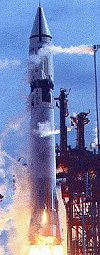
MCTV 8Spacecraft:(no serial number) Launch Vehicle: Atlas D/Centaur Scheduled Launch: 15 Jan 1965 Last Scheduled: 30 Aug 1961 |
|
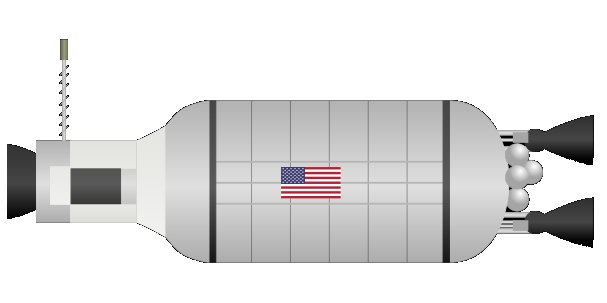
Description: 1st Atlas Centaur unmanned docking target for manned Gemini |
 |
 |
 |
|
|
||||||||
|
|
||||||||
|
|
"If the Mark II spacecraft showed itself able to support a crew for seven days or more and if rendezvous proved to be practical, then the advanced program based on the Mark II might 'accomplish most of the Apollo mission at an earlier date than with the Apollo program as it is presently conceived.' By taking full advantage of the new spacecraft and rendezvous technique, 'it is a distinct possibility that lunar orbits may be accomplished by the interim spacecraft after rendezvous with an orbiting Centaur.' This prospect was the subject of an appendix to the development plan. "Centaur was a second-stage vehicle then under development that would use high-energy liquid hydrogen as its fuel. If Centaur were inserted into orbit by Titan II, it would have enough power after docking to boost the spacecraft to escape velocity. The deep-space version of Mark II differed from the rendezvous type only in having backup navigation gear and extra heat and radiation protection, 270 kilograms more on a 2,900-kilogram spacecraft. The appendix explored two possible mission sequences. One simply added four flights to the ten in the Mark II program. The first two extra flights were deep-space missions, with Centaur boosting the spacecraft into an elliptical orbit with an apogee of some 80,000 kilometers to study navigation and reentry problems. The last two flights, scheduled for March and May 1965, were circumlunar, and the whole package added only $60 million to the cost of the basic Mark II program. "The alternative was an accelerated program, nine flights in all. The first three flights were the same in both programs - an 18-orbit unmanned qualification and radiation test, an 18-orbit manned qualification test, and a manned long-duration test. In the speeded up program, the fourth and fifth flights developed the techniques of rendezvous and docking with Agena B as the target. Centaur launched by Titan II then replaced the Agena for the rest of the program - two deep-space missions and two flights around the Moon. This faster program put the first Mark II in lunar orbit in May 1964 for a cost not much greater than the basic 10-flight program: $356.3 million versus $347.8 million." Although Hacker and Grimwood claim that the launch vehicle for the Centaur upper stage was a Titan II, no such launch vehicle either existed or was in development at the time of the Gemini report; in contrast, Altas Centaur development was well underway. General Dynamics delivered the first Atlas Centaur launch vehicle to Cape Canaveral in October 1961, only two months after the Gemini report. Martin did not propose the Titan 3BAS2 variant, a Titan core with two Algol 2 solid strap-ons and a Centaur third stage, until the mid-1960s, and it was not funded. Secondly, LC-19 was the only Titan launch complex that was configured for space launches. This means that both the Centaur and the Gemini would have had to have been launched from the same pad. The Gemini 7 and Gemini 6A missions demonstrated a launch pad turnaround of 11 days. Had the Centaur been launched first, a lot of its liquid hydrogen would have boiled off in 11 days. Launching the Gemini first also would have had its problems. As a new system, confidence in successfully orbiting the Centaur would have been lower than for the Agena, and two of those were launch failures in the Gemini program, thus a Gemini crew would have been waiting in orbit for 11 days for a Centaur launch that might well have failed. Even if the Centaur achieved orbit and docking were successful, it would have been a seven-day flight around the Moon and back to Earth, as demonstrated in the Soyuz 7K-L1 program, making a total flight time of 18 days. The Gemini system specification was only 14 days. A six-day flight around the Moon was possible, as demonstrated by Apollo 13, but that would have meant a higher reentry speed. Of course, configuring the same pad for both Gemini and Centaur launches would been difficult as well as having been expensive, just as upgrading one of the other Titan pads also would have been expensive, yet the mid-1961 Gemini report claimed that a circumlunar Gemini program would have cost only $60 million more than the basic Gemini program. Meanwhile, LC-36 was already being readied for Atlas Centaur launches; that money was already spent. References:
|